Situational Analysis Of Beekeeping In Pakistan
By: Dr. M. Asif Aziz
Beekeeping in Pakistan has emerged as a significant agricultural activity, with a substantial number of practitioners contributing to the country’sapicultural landscape. As of current records, there are over 10,000 dedicated beekeepers actively engaged in apiculture, and an additional 20,000 allied stakeholders play a crucial role in supporting and enhancing the industry. The collective efforts of these individuals contribute to an impressive annual honey production of approximately 13,500 tons
Pakistan boasts several prominent honey-producing regions, with notable hubs located in Punjab, Khyber Pakhtunkhwa, Gilgit-Baltistan, and Azad Jammu & Kashmir. Among these regions, Punjab emerges as a primary contributor to the country’s honey production, owing to the presence of renowned honey-growing areas such as Rawalpindi, Attock, Jhelum, Chakwal, Sargodha, Mianwali,
and Layyah. However, there are also many popular areas for honey production in Khyber Pakhtunkhwa like Karak, Kohat, Bunnu and Nizampur. The honey produced in Pakistanencompasses a diverse range ofdistinct varieties, reflecting the country’s rich natural resources andecological diversity.
These varieties include Sidr, Bhaiker, Carrissa, Russian olive, Robinia, Acacia, eucalyptus, Loquat, Berseem, Brassica, Shain, Shan shobe, and Thyme.
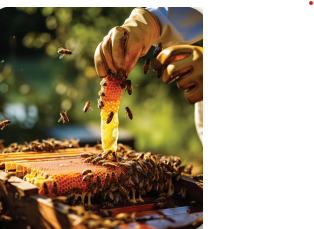
One particularly noteworthy aspect of Pakistan’s beekeeping industry is the export potential associated with Beri honey. Renowned for its unique flavour profile, captivating aroma, and remarkable medicinal properties, Beri honey emerges as a flagship productwith significant export value. Its distinctiveness not only highlights Pakistan’s natural biodiversity but also positions the country as a notable player in the global honey market. The production and export of Beri honey
serve as a testament to Pakistan’scapacity to deliver high-quality sought-after honey products to international markets. This not only augments the country’s economic prospects but also reinforces its reputation as a reliable source of premium honey offerings on the global stage. The honey value chain in Pakistan is strategically dispersed across five key locations, namely Peshawar, Islamabad, Rawalpindi, Lahore, and Karachi. Peshawar stands out as the central trading hub within this network. It serves as the primary nexus for major exporters and processors operating within the honey industry. In Peshawar alone, there exists a robust network of over 1300 traders actively engaged in facilitating transactions within the honey value chain. Furthermore, additional support is extended by more than 500 traders dispersed across various regions of Khyber Pakhtunkhwa (KP) and Punjab. These traders play a pivotal role in bridging the gap between local producers and international buyers by ensuring a steady supply of honey and related value-added products.
Areas Of Opportunity
- Upgradation of honey processing, quality processing, storage and marketing through providing SS and food-grade honey processing equipment/tools e.g. extractors, cleansing/- filtering machines, honey extraction kits, refractometer, food-grade cans etc.
- Introduction and implementation of best practices related to production and processing through a series of capacity building sessions and B2B sessions to strengthen the sector capacity and to improve the connectivity.
- Access to market efforts (nationaland international) to improve marketvisibility, product placement, B2B and B2C engagements
- Quality and food safety certifications at processing stage.
- Induction of ICT technology for marketing and management e.g. website, SEOs and digital marketing
Constraints
- Lack of modern processing equipment, tools, machinery and testing equipment across the value chain especially at producer/processor side damage the quality, purity and physical characteristics of honey at veryinitial stage
- Poor product standardization, packaging and access to market efforts.
- Lack of food safety, organic and quality assurance standards restricting our exports to low-end trader’s markets where most of the honey sold at wholesale price.
- Lack of strategic marketing of this high-value sector carrying tremendous economic potential and employment opportunities.
- Lack of formal exports to international markets

A significant portion of beekeepers in Pakistan are primarily trained in honey production and hive multiplication, particularly during the spring season. However, a relatively smaller segment of beekeepers engages in the production of royal jelly, beeswax, bee pollen, and propolis. Despite efforts, previous reports indicate that approximately 30 % of harvested honey suffers from compromised quality, highlighting challenges within the harvesting process. Moreover, beekeepers encounter difficulties in managing mites and diseases, often due to a lack of comprehensive knowledge and implementation skills in disease control and prevention strategies. While researchers and government institutes endeavor to offer technical support to beekeepers, honey traders, and exporters, there remains a substantial gap in enhancing their knowledge, skills, and capacity-building capabilities.
To tap into high-end global markets, there exists an urgent need to adopt and adhere to best practices in beekeeping, along with implementing stringent quality assurance measures throughout the honey value chain. This includes establishing robust systems for traceability and monitoring to ensure product quality and safety standards are consistently met.
Addressing these challenges demands a collective effort at the national level, involving collaboration among stakeholders from government agencies, research institutions, beekeeping associations, and the private sector. By prioritizing capacity-building initiatives, promoting knowledge exchange, and implementing comprehensive quality control measures, Pakistan can strengthen its position in the global honey market and unlock opportunities for sustainable growth and
market access

- Admin Office
-
Entomological Society of Pakistan.
A-145, Akbar Road, Ghouri Town Phase-3
Islamabad 46000
- Phone : +(92) 318-5128617
- Email : Info@entosociety.pk
- Email : entosocietypk@gmail.com
Quick Links
Copyright © entosociety.pk. Created By RK-Marketing