Discovery of New Termite Species in California Brings Notable Insights for
Termite Pest Management
By: Andrew Porterfield
In southern California, subterranean termites in the genus Reticulitermes are a common scourge, responsible for significant economic damage in that part of the state.
Early studies of these termites indicated that only two pest species existed—Reticulitermes hesperus and Reticulitermes tibialis.However, a 2023 study by Chow-Yang Lee, Ph.D., endowed presidential chair in urban entomology at the University of California, Riverside, and his fellow researchers suggested that there could be as many as four undescribed species of Reticulitermes in California, one additional to southern California.

In a study published in July in Annals of the Entomological Society of America, Lee and colleagues confirmed the existence of an undescribed species of subterranean termite in Southern California, which they’ve named Reticulitermes rusti. The study was led by Joanne Chen, a Ph.D. candidate in Lee’s lab, joined by fellow researchers from UC Riverside, the U.S. Forest Service, National Taiwan University, and UC Agriculture and Natural Resources. The researchers named the new species after retired UC Riverside professor Michael K. Rust, Ph.D., “who has contributed significantly to our knowledge of the biology and management of subterranean termites in southern California for the last 50 years,” they write.
The new study could explain why some previous work reported low foraging activity and poor bait station fidelity when looking for R. hesperus in southern California—essentially, because R. rusti behaves differently from R. hesperus. “This is why accurate species identification is crucial in urban pest management, as different species may exhibit distinct behaviors and biological traits that could influence management strategies,” the researchers say in their report Chen and the team were able to identify R. rusti termites based on a comprehensive use of several different techniques. These included phylogenetic evidence, genotype clustering, morphological comparisons, and previous chemotaxonomic data based on analysis of hydrocarbon components in the termite cuticles, or exoskeltons.
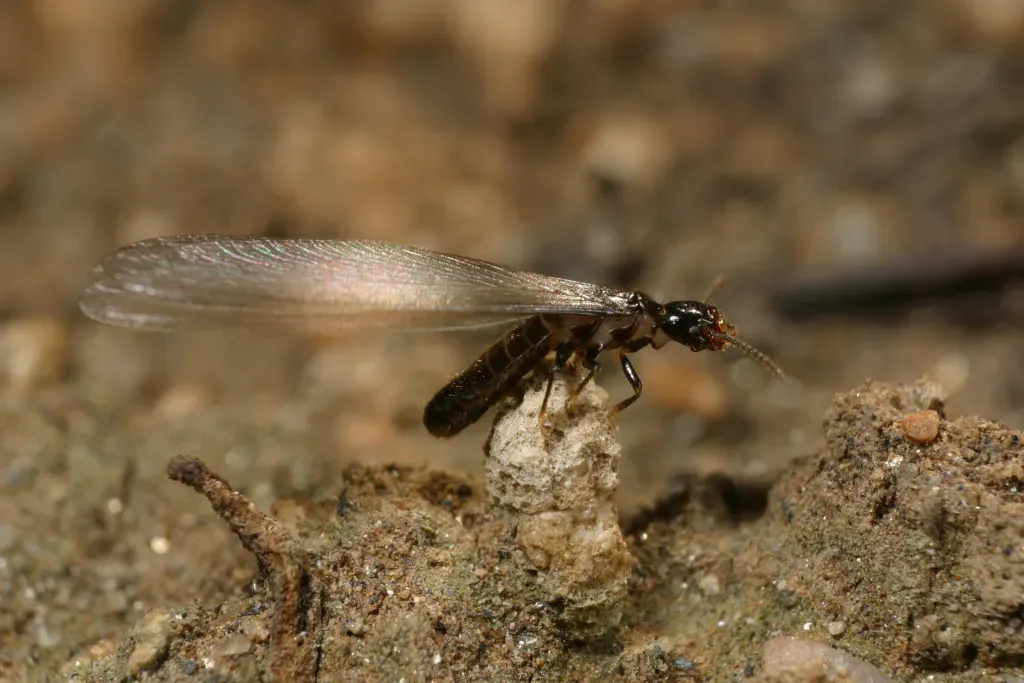
A new study confirms that two known species of subterranean termites in southern California are actually three. The new species, Reticulitermes rusti (pictured here, in winged alate form), joins R. hesperus and R. tibialis, and the distinction will allow for pest management strategies that are more specific to each. It also could explain why some pest management efforts for R. hesperus have fared poorly in the past—essentially, because R. rusti behaves differently from R. hesperus, says Chow-Yang Lee, Ph.D., endowed presidential chair in urban entomology at the University of California, Riverside, whose team conducted the study. Lee notes that a 1920 description of R. hesperus mentioned that the species swarmed at two different seasons (fall and spring). “I am pretty sure that R. rusti was already present in Southern California at that time,” he says. (Photo courtesy of Dong-Hwan Choe, Ph.D.)
In this round of analysis, the researchers collected additional samples to more confidently determine the existence of a new species. Their genetic studies, using three mitochondrial loci (16S ribosomal RNA, and cytochrome oxidases I and II) and microsatellite sites, distinguished the new R. rusti from the known R. hesperus and R. tibialis. Measurements of morphological characteristics also supported the existence of a new species. Sequencing of COI and COII genes showed that while R. rusti was genetically closer to R. tibialis, its soldier caste is morphologically closer to R. hesperus, underscoring the need to look at mitochondrial genes like COI and COII.
Confirming the new species was a challenge for the researchers, because the termites in this genus have characteristics that overlap. “It is often challenging to identify based on morphological characteristics and measurements alone,” Lee says. “Before the advancement of molecular tools, it was not possible to distinguish them. That’s why in the past, we only knew there was R. hesperus, which was a pest subterranean termite species in California, and R. tibialis, which is the arid species. The combined use of morphological and molecular characteristics enables us to sort out those species that are not easily distinguishable from those we already know.”
It is not clear when this branching of species occurred or what caused it. However, a 1920 description of R. hesperus mentioned that the species swarmed at two different seasons (fall and spring). “I am pretty sure that R. rusti was already present in Southern California at that time,” Lee says.
The researchers recommend that future studies should compare the biology and pest status of both R. hesperus and R. rusti. “With this knowledge, species-specific pest management strategies can be developed to accurately predict and implement effective measures to mitigate the damage caused by Reticulitermes infestations,” they write.

- Admin Office
-
Entomological Society of Pakistan.
A-145, Akbar Road, Ghouri Town Phase-3
Islamabad 46000
- Phone : +(92) 318-5128617
- Email : Info@entosociety.pk
- Email : entosocietypk@gmail.com
Quick Links
Copyright © entosociety.pk. Created By RK-Marketing