Defend Your Grains: The Menace of Larger Grain Borer Uncovered
Introduction:
Name: Prostephanus truncates
Family: Bostrichidae
Order: Coleoptera
Commonly refers to as the larger grain borer, related to Rhyzopertha dominica, which is relatively smaller and refers to as the lesser grain borer. Its body size varies 6 mm (0.24 in) as compared to 3 mm (0.12 in) long in R. dominica. The optimum conditions for their surveillance are 80% relative humidity and 32 °C, and also the availability of the foods. The larger grain borer is the serious pest of the dried grain, especially maize and dried cassava in Africa. It completes its life cycle within 27 days. ‘Its attack continues from field to storage in the maize, storage bags, plastic also feeds on wood, bore, and weevil only feeds on the heart of the grain, and the larger grain borer bores into grain, leaving empty shells. It remains ready to attack when new maize comes into storage; they remain in the old storage. It also faces difficulty entering the dry maize.

Larger Grain Borer: A Complete Guide to Its Life Cycle and Traits
Adult:
The larger grain borer has a cylindrical shape, is small (4 mm) in length, and has a body color of reddish brown to dark brown on its body surface. It has many small tubercles, and it is flat and steep.
Antennae are 10 segmented and have a loose, three-segmented club, which is densely covered with short hair. On the clypeus, females have relatively greater-height tubercles than males, which makes them distinguishable from males.
Larvae and pupa:
Larger grain borer larvae are scarabaeiform; they are white, fleshy, and sparsely covered with hairs; the sides are parallel, i.e., don’t taper; relative to the size of the body, legs are shorts, and the head capsule is small; the pupa is initially white but darkens with age depending on the size and shape of the genital’s papillae; may be sexed-based larvae hatched from the egg after about 4 days; the main pupal development period is 4.5 days.
Eggs:
The larger grain borer eggs are darkened from white to yellow and shape broadly ellipsoid, glossy. Their size varies from 670 μm long and 400 μm wide. From egg to adult total development period is almost 25 days.
DAMAGE:
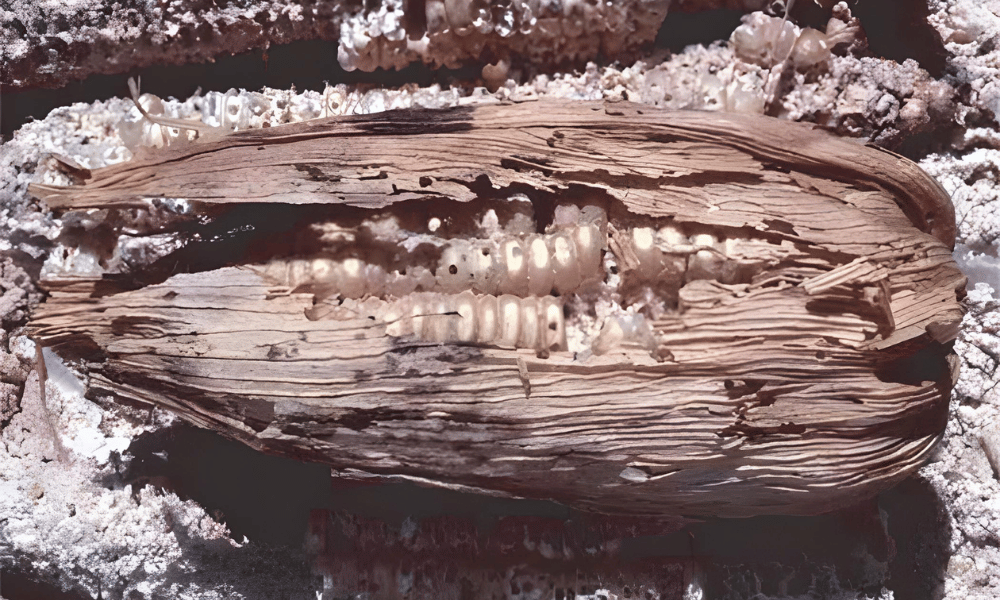
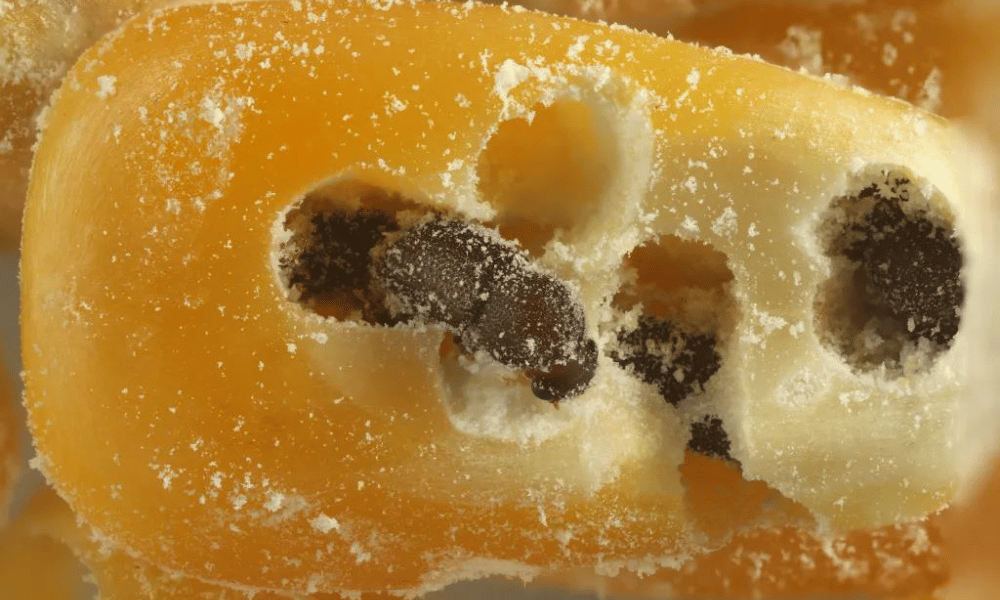
The larger grain borer is commonly a pest of the whole grain, especially corn and cassava root. In the grain and the grain mass, the adults chew the kernel and lay their egg into the kernel. When adults come out of the hole and roam in the grain, then the damage is seldom noticed. Larvae and pupa are also found in the kernel and holes, which are made from the adults.
Detection and inspection:
The larger grain borer can be detected in detail by applying the flying traps, such as funnel, delta, or wing traps, baited with the male released aggregated pheromones of the P. truncates. 100 mm from the store, these traps should be placed, which contain maize and cassava. Some leaflets give recommendations on the use of the pheromone traps to monitor, for long-term, routine trapping.
Control method
Chemical control:
To control their population and infestation of the larger grain borer, using a contact chemical insecticide, in many small-holder farms setting use dilute dust. Synthetic pesticides are typically provided to control the larger grain borer. This pest is more susceptible to organophosphate compounds; this is a mixture of various formulations like pyrethroids and organophosphate compounds. Fumigation with gaseous, some anthranilic diamide, chlorantraniliprole, and formulation of insect growth regulators with pyrethroid, deltamethrin.
Biological control:
Some predatory beetles are also known to effectively control living organisms of larger grain borer. both larvae and adults of the T. nigrescens on larger grain borer eggs and larvae. Several hymenopteran parasitoid species identified parasitizing to larger grain borers in both pest native and invaded ranges; also, Cosmopolitan wasps show highly efficacy against all stored grain pests.
Entomopathogens, especially fungi, against P. truncates and the fungus Beauveria bassiana in a maize storage setting can reduce a larger grain borer infestation.
Cultural control and sanitary methods:
Applying sanitary measures in grain storage facilities is critical to mitigating stored product pest infestation. Some examples include closing or sealing cracked kernel containment and grain dust and removing infested residues. Remove the surrounding wooden structure and other source of foods relatively some new colonizing individuals are needed to cause economically damaging infestation level, remove plants and other stalks of the plant and other residues from field after harvesting, through slashing, plowing, disking, and burning, so that these field sanitations can have adverse effects to soil moisture, soil organic content, and reduce forage availability.
Physical & mechanical control:
Larger grain borer has effective control by increasing the temperature treatment of stored grain at long duration; heat treatment of moderate temperature (e.g., 45.5°C for 4 h or 47°C for 2 h) can cause complete mortality of Truncates, which appear to be the most heat-tolerant life stages, while also minimizing negative effects to maize or sorghum grain germination. similarly, cold exposure at 9°C for 4 h, -11°C for 2 h, -13°C for 1 h, or -15°C for 0.5 h resulted in 100% mortality of the adults.
For larger grain borer control and reduce infestation for grain, also design the hermetically sealed containers, bags, and oxygen limit can be effective to kill larger grain borer.
Follow us
Stay Connected
Subscribe to our newsletter for the latest updates on events, research, and certification programs.
- Admin Office
-
Entomological Society of Pakistan.
A-145, Akbar Road, Ghouri Town Phase-3
Islamabad 46000
- Phone : +(92) 318-5128617
- Email : Info@entosociety.pk
- Email : entosocietypk@gmail.com
Quick Links

Copyright © entosociety.pk. Created By RK-Marketing