The Silent Grain Killer: Understanding the Lesser Grain Borer
Introduction:
Name: Rhyzopertha dominica
Family: Coleoptera
Order: Bostrichidae

What Does a Lesser Grain Borer Look Like?
A Guide to Identifying This Global
Lesser grain borer belongs to the family Bostrichidae and is a monotypic genus of beetle family, Lesser grain borer is commonly called powder post beetle; its other name in different countries is American wheat weevil, Australian wheat weevil, and also called stored grain borer. It is located worldwide where stored products and stored cereal grain are situated; it is a major pest of peanuts; its first attack on wheat was observed in Australia.
The lesser grain borer body size is almost 2.1-3.0mm, and their body color is reddish brown, also have 11 segmented antennae and have 3 segmented antennal clubs. With the base of the body pronotum located with no depression, and also show wrinkled appearance on the basal part of the pronotum. In the anterior margin, distinct tubercles are found; it has elytral strioles that are clear and rounded at the apex; it also has bent setae that are short and yellowish. Generally, there is no major difference between male and female lessor grain borer.
Dominica has a worldwide distribution, it also prefers the warmer temperature zone between latitudes 40°North and 40°South, Lesser grain borer is mostly found in forested and grain storage environments, and through commercial transportation, humans play a role in their wide spread.
Diet of lesser grain borer:
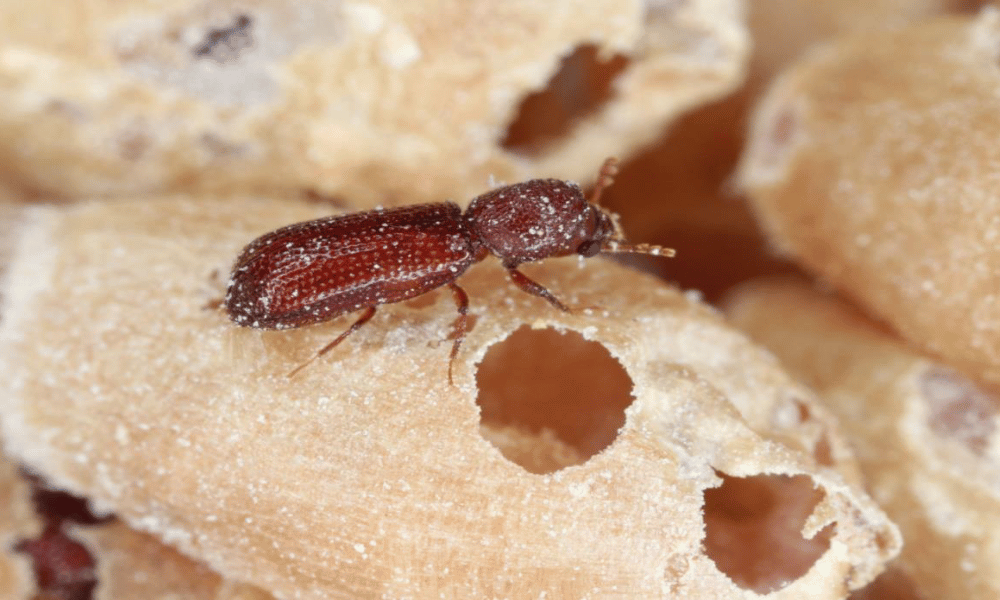
Lesser grain borer has various substrates that make up the resources and diet, including grain, such as malt barley, pearl millet, wheat, rice, sorghum, and family poaceae, chickpeas, peanuts, and beans from the family Leguminosae. also prefer their feeding on the dry grain. Lesser grain borer larvae and adults also feed on the whole grain.
Life cycle of the lesser grain borer
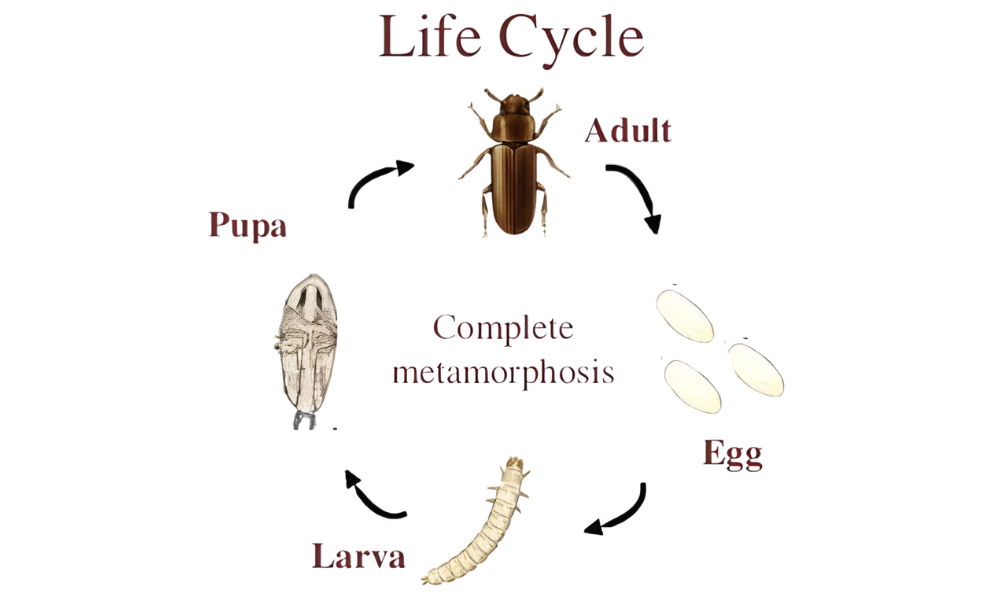
Egg, Larva, Pupa, Adult
After the individual encloses from the larval period, its mating behavior flows within 24 hours. Its body length is about 3mm long and it is cylindrical and has a dark reddish-brown color, adult beetle had been hidden beneath the pronotum; an adult may live up to 240 days. female lays eggs in batches up to 30 which may last up to 500-over 3 months. The optimum temperature for egg laying is 20° C to 34° C and 14 percent grain moisture content.
Larvae and pupae:
White-colored, c-shaped, and immobile larvae, it feeds and pupates inside the tunnel in the grain kernel. The normal development period from egg to adult is 58 days, but in 25 days under optimal conditions, they develop into adults.
How to Protect Your Grain Storage from Lesser Grain Borer Infestations
Physical control method:
To manage the lesser grain borer infestation, commercial agricultural methods should be implemented. It would happen when we minimize the pest migration and build up within grain storage areas before the storage, complete cleaning of equipment, during harvesting, sealing, storage, and spreading bins and units, and also remove any grain spills. In storage areas, closely monitor temperature because it can influence the insect population. Keep temperature below 15 °C, which is unfavorable for insect reproduction growth. All stored grain products are insects, such as lesser grain borer or rusty grain beetle temperature needed to kill them.
- 20° C for one week
- 15° C for four weeks
- -10° C for eight weeks
- -5 for 12 weeks
Follow us
Stay Connected
Subscribe to our newsletter for the latest updates on events, research, and certification programs.
- Admin Office
-
Entomological Society of Pakistan.
A-145, Akbar Road, Ghouri Town Phase-3
Islamabad 46000
- Phone : +(92) 318-5128617
- Email : Info@entosociety.pk
- Email : entosocietypk@gmail.com
Quick Links

Copyright © entosociety.pk. Created By RK-Marketing