
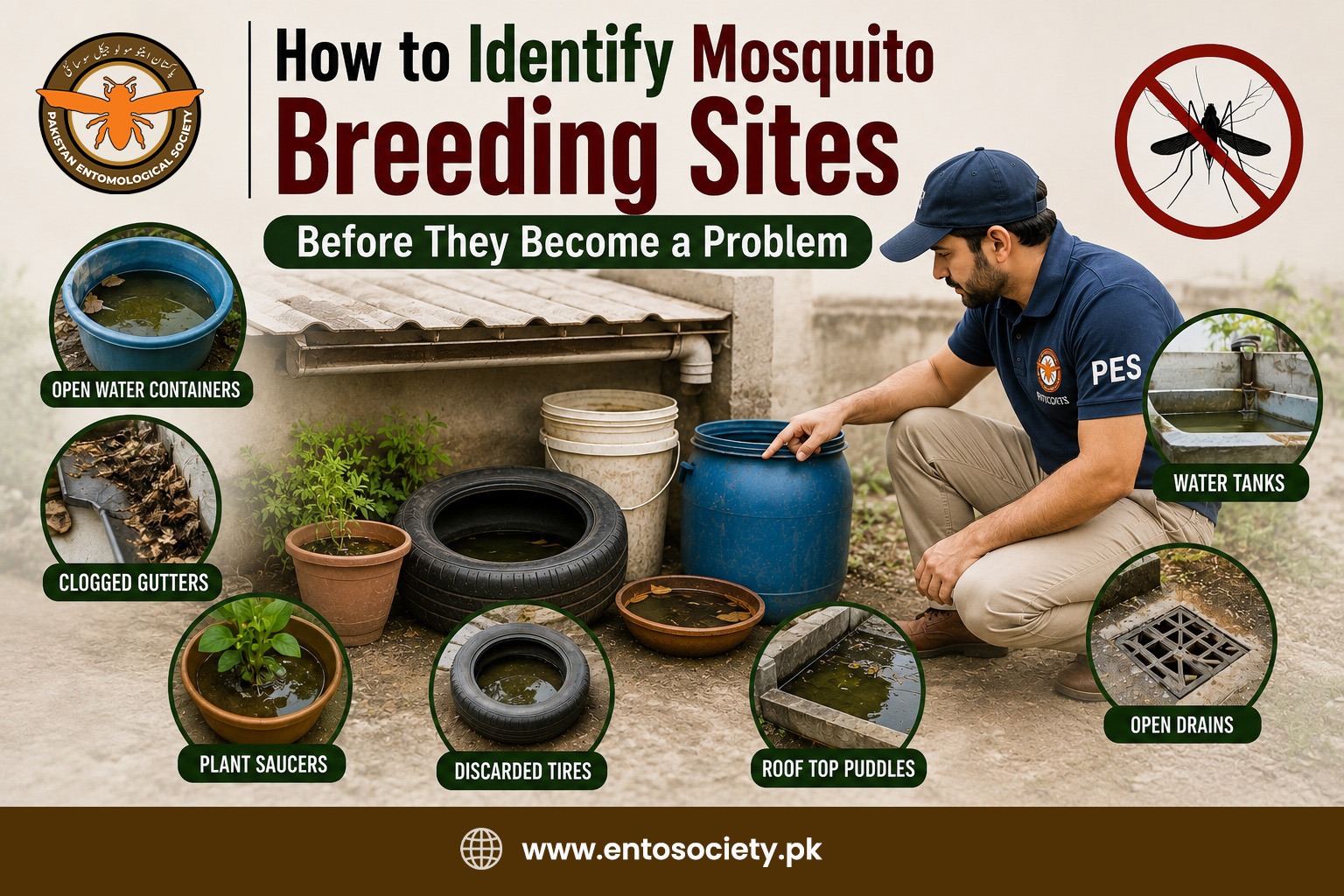
Mosquito infestations usually begin with water; standing water on the road, sewage issues, and standing water after rain help mosquitoes breed from one generation to another before you hear any buzz at dusk. Timely identifying mosquito breeding sites is helpful in keeping yourself and your loved ones safe.
Early detection of mosquito breeding sites is the most important action that can be taken to prevent an infestation and is fundamental to Integrated Pest Management (IPM). The Pakistan Entomological Society aims to educate homeowners, facility managers, and communities about the biology of mosquitoes to help them take action early before they become just another nuisance; mosquitoes are carriers of serious public health threats, such as dengue and malaria.
This guide explains the places that mosquitoes breed, signs to look for, and how to examine and prevent mosquitoes by using science-based, environmentally responsible methods.
Why Mosquito Breeding Site Identification Matters
Once adult mosquitoes have hatched, it is a lost cause to treat them. Within one week, hundreds of new mosquitoes can develop from a single container of stagnant water, and early detection is always more effective and sustainable than reactive treatment.
Mosquitoes breed quickly, and small, unnoticed breeding grounds can quickly become a large infestation in days. The concept of source reduction is the basis for all mosquito habitat management: “Eliminate the conditions that allow mosquitoes to develop rather than killing them repeatedly as adults. It is an important issue for public health; fewer breeding sites mean fewer disease-carrying mosquitoes in neighbourhoods, schools, and workplaces.
Understanding the Mosquito Life Cycle
Understanding mosquito development is a useful aid in locating breeding sites. There are four stages of the mosquito life cycle, and three of them can only occur in water.
- Eggs: Female mosquitoes lay mosquito eggs directly on or near standing water. Some species deposit their eggs on rafts on the water’s surface, and others lay their eggs just above the water level, which hatch when the water rises due to rain.
- Larvae: Mosquito larvae, or “wrigglers”, are aquatic organisms that feed on organic matter and come up to the surface of the water to breathe.
- Pupae: Mosquito pupae are non-feeding, transitional stages that can often be seen tumbling near the water’s surface just prior to emergence as adults.
- Adults: A fully grown adult mosquito emerges from the egg in only 7-10 days in warm weather and can start the cycle again.
Access to standing water is critical to the first three stages, so disrupting standing water is the most effective way to interrupt the mosquito life cycle before a new generation of biting adults is produced. If you hire a professional for mosquito pest management, then they help you to stop mosquito breeding.
Common Mosquito Breeding Sites Around Homes and Businesses
Mosquito breeding areas are found much closer to home than expected, and are often small. The first step in effective mosquito habitat management is a detailed inspection of the exterior and interior of homes.
Outdoor Areas
- Rain gutters and downpipes for watering.
- Bird baths that aren’t cleaned regularly
- Containers, buckets, or bottles left outdoors
- Worn tires that collect water in the curves of the treads, and
- Clogged roof gutters
- Low areas of the yard or poor drainage facilities
- Construction materials and debris are used correctly.
- Outdoor toys for kids.
- Tarps with pooling folds
- Open storage containers for water (storage drums or tanks)
Indoor Areas
- Basements where there is leftover water in the basement drains
- Utility spaces that have inadequate drainage.
- Air conditioner drip trays
- Clean water storage containers, particularly uncovered ones.
- Plumbing leaks that create standing pockets of water are a source of problems.
All of these can serve as breeding areas if not disturbed for several days or longer. Larvae can only be detected if pests are regularly checked in indoor and outdoor areas.
Signs That Mosquitoes Are Breeding Nearby
Don’t always have to look for the water source; mosquitoes leave behind plenty of clues of breeding around your house. Watch for:
- Mosquito larvae (“wrigglers”) can be seen swimming in jerky movements close to the surface of standing water.
- Mosquito pupae rolling around on the water’s edge.
- A high number of mosquitoes, particularly during early morning or evening hours
- Repeated bites to a particular spot in your yard or home
- Dull, dirty, or algae-infested water.
- Buzzing was concentrated in areas with vegetation and higher moisture levels.
- The undersides of leaves and dense vegetation are where mosquitoes rest during the day.
If you detect any of these symptoms simultaneously, it is a good indication that a breeding site is within 200 meters; most mosquito species do not fly far from their breeding sites.
How to Inspect Your Property for Mosquito Breeding Sites
It pays to have a regular mosquito inspection program rather than a one-off cleanup. It’s best done through weekly and monthly checks, which help avoid omissions.
Weekly Inspection
- Empty and clean out water-holding containers.
- Inspect gutters for clogs and puddles.
- Check in-house / out-of-house drains.
- Look under decks and porches for hidden puddles.
- Inspect plant saucers, plant beds, and mulch areas.
- Check water tanks and hoses for cracks and open lids.
Monthly Inspection
- Check the roof surface for low areas where rainwater can collect.
- Inspect irrigation systems for leaks or overflowing systems.
- Check outdoor equipment (wheelbarrows and not-in-use pots) for existing water.
- Evaluate the property following a heavy rain when new pooling is likely to occur.
This can be worked into a routine and is one of the easiest ways to implement good vector management without using chemicals.
How to prevent natural mosquito breeding.
With breeding locations or sites identified, prevention is all about consistent environmental sanitation and a few structural changes:
- Eliminate standing water, including small amounts.
- Regularly clean out gutters to avoid clogging that could result in rainwater building up.
- Plant in poorly drained areas with alternative drainage systems in place.
- Tightly close all water storage containers/tanks.
- Keep the landscape maintained; trim back overgrown areas where adult mosquitoes rest.
- Where appropriate, try to control the mosquito population using biological methods, such as introducing natural predators of the larvae in ornamental ponds.
Do regular environmental sanitation activities to remove water collection spaces, such as debris, etc.
Reducing the source is at the core of preventive pest management and typical of the environmentally conscious philosophy that IPM embraces over treating symptoms.
Can Mosquitoes Breed in Clean Water?
One of the most common misunderstandings in mosquito prevention is that mosquitoes can’t survive in water. The belief that mosquitoes cannot survive in water is one of the most common misunderstandings in mosquito prevention. Many people believe that mosquitoes only breed in dirty water, but this is not true. Mosquitoes can be reared in clean or dirty water, and mosquito species preferences are quite diverse; some, such as certain Aedes species (dengue vectors), prefer clean, still water in saucers, flower pots, bird baths, or uncovered buckets.
Just a bottle cap’s worth of clean water can be enough to complete a mosquito’s entire breeding cycle. That’s why if a container’s water looks clean, it is never safe to leave it uncovered during an inspection.
Why Professional Mosquito Pest Management Essential
Mostly, people want to handle self-inspection for mosquitoes and use market-available sprays and DIY ideas like using mint leaves to avoid the infestation, but to avoid the infestation, you need professional mosquito pest management services, especially for larger properties that have more potential for mosquito breeding, education centers like schools, and gated communities that have a common sewerage system.
In this situation, you need to hire a professional mosquito management and inspection service that handles mosquito infestations through surveillance, habitat assessment, and intervention, rather than an ad hoc approach. With the Pakistan Entomological Society, you get professional help and IPM training that support pest control services for professionals, close this gap, and facilitate the transfer of knowledge from the laboratory to the field for vector control.
Frequently Asked Questions
Check for any stagnant water with no wind for several days, and also any possible mosquito larvae or pupae in the water. There is also a high likelihood that a particular area will experience increased mosquito activity.
Mosquitoes can go through their entire life cycle (from egg to biting adult) in just 7 to 10 days, especially in warm weather, which is why weekly inspections are so important.
Yes. Clean water is as good as dirty water for mosquitoes to breed in, and some species prefer it. All pond and pool water, even clear water, should be drained or disinfected.
Common containers and drainage areas should be checked weekly; monthly checks should be undertaken on roofs, irrigation systems, and post-rain water accumulation.
Final Words
It is much better to take steps to eliminate mosquito breeding areas early in the season, before the infestation becomes extensive. Knowing where mosquitoes breed, being aware of the signs of an early infestation, and having a routine for checking for them can help prevent the spread of mosquitoes. Regular inspections not only help safeguard your property but also minimize health risks in your community. Entosociety will continue to support such science-based, preventive ways of fighting mosquitoes, site by site in Pakistan. Entosociety’s advanced research and training programs can help you stay safe and avoid mosquito breeding.
