
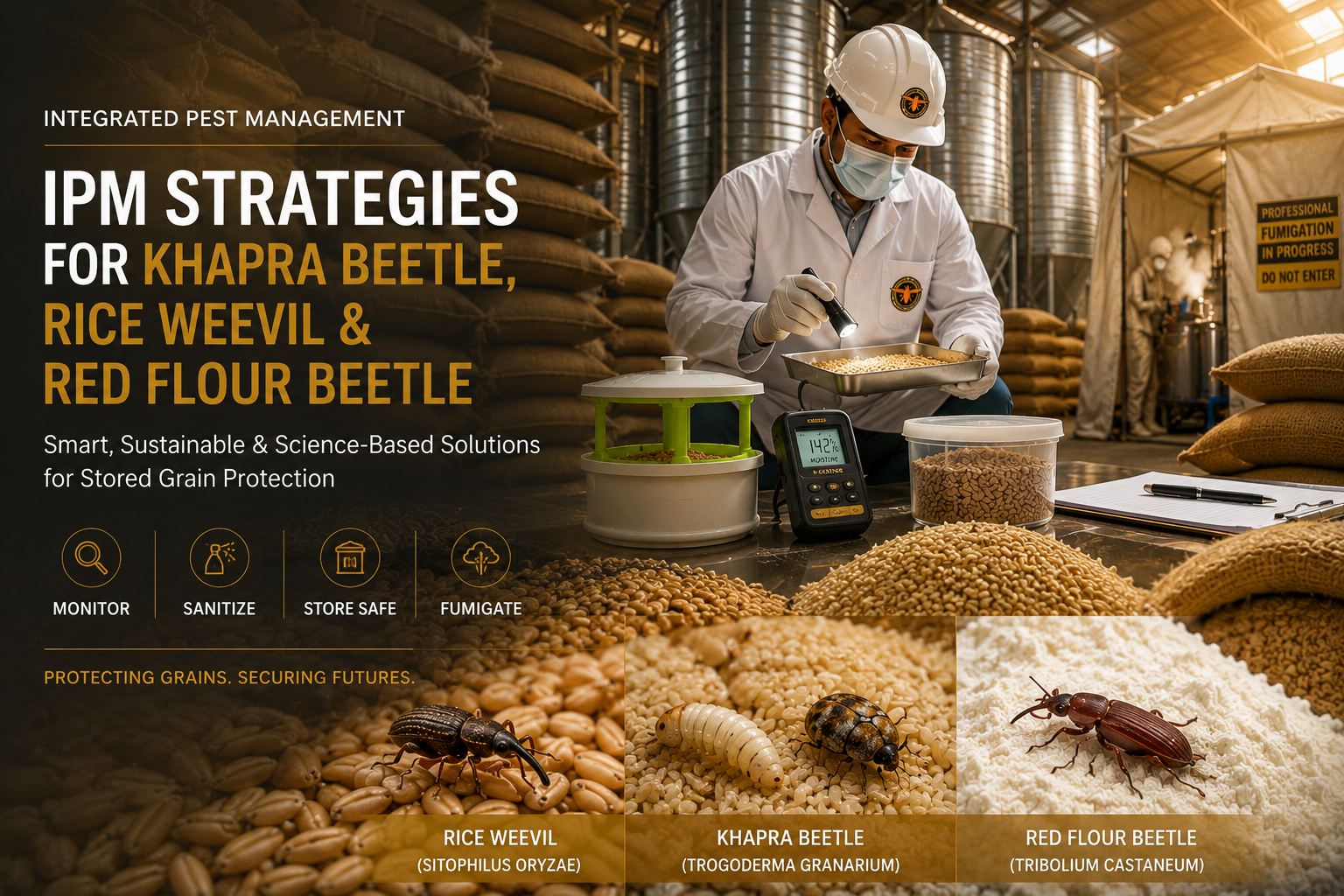
Stored grain pests are small insects that infest rice, wheat, flour, and other foods stored in households, warehouses, storage godowns, and silos. Rice weevils, khapra beetle, and red flour beetles are major problems in Pakistan for stored food every year. These bugs cause grain spoilage, food loss, and significant losses for businesses and farmers.
This is why Integrated Pest Management (IPM) is very important. Integrated Pest Management is a smart and safe approach to pest control, which relies not only on Pesticides. It employs cleaning, monitoring, safe storage, and environmentally friendly techniques to prevent the spread of pests.
Many people in Pakistan today apply pest management practices to protect grains and food storage areas to prevent the spread of pests.
IPM programs keep homes, farms, and warehouses clean and safe. It also promotes sustainable agriculture and minimizes food waste.
Pest control companies in Pakistan have shifted their attention to the use of more effective and safer methods for long-term pest prevention. Proper monitoring and management of stored grain pests can control them effectively.
What is Integrated Pest Management (IPM)?
Integrated Pest Management (IPM) is a pest management strategy that is safe and smart. IPM incorporates multiple approaches to prevent pests from increasing and spreading rather than relying on sprays or chemicals.
These methods include:
- Cleaning storage areas
- Checking grains regularly
- Controlling moisture and temperature
- Applying pesticides in a safe manner, when necessary
- Properly storing food.
Homes, farms, grain warehouses, silos, and food factories employ IPM to manage pests effectively.
Importance of IPM in Pakistan
In Pakistan, people store large quantities of wheat, rice, flour, and other grains.
Insects may become a real issue in a short period of time in hot weather and under poor storage conditions. That is why IPM is gaining importance in Pakistan every year.
IPM helps:
- Prevent any damage to food. Keep food safe from damage.
- Reduced chemical use
- Improve grain quality
- Make clutter-free and secure storage spaces.
It’s also environmentally friendly as it ensures the safety of human, animal, and environmental health.
IPM offers advantages for both producers and the environment. IPM provides producer and environmental benefits. There are many benefits of IPM:
- Quicker decomposition of waste materials.
- Reduced use of harmful chemicals.
- Better food safety
- Long-term pest prevention
- Lower grain losses
- Cleaner storage systems
Modern pest management science supports IPM, making it a safer and more environmentally friendly approach than traditional pest control methods.
Rice Weevil IPM
A rice weevil is a small insect that infests stored grains, such as rice, wheat, corn, and pasta. The rice weevil’s scientific name is Sitophilus oryzae. Dark brown/black and has a long snout. One of the significant pests of the rice storage system in Pakistan is the rice weevil. These insects have a tendency to multiply rapidly in the grain bags and storage bins.
Rice Weevil Life Cycle.
The rice weevil life cycle has four stages:
- Egg
- Larva
- Pupa
- Adult
The female rice weevils deposit eggs into the grain. Eggs hatch into larvae, which gnaw on the inside of the grain. Once grown, they are adult weevils that repeat the cycle. A single female lays hundreds of eggs, causing infestations to increase rapidly.
Rice weevil pests show the following symptoms:
- Turned up rice grains with small holes in the grain.
- Dust that looks like powder around food containers
- Rice is infested with small black insects.
- A bad odor from stored grains.
- Damaged or broken grains
Rice weevils may cause serious damage to stored food if not properly controlled early.
Control of rice weevils.
You can use several IPM techniques for effective rice weevil pest control.
- Monitoring: Inspect rice and grains frequently for insects and damage.
- Proper Storage: Keep grain in tight containers to prevent insects from getting in.
- Cleaning Procedures: Wash shelves, storage bins, and grain bags frequently.
- Heat and Freezing Methods: Rice weevils can be destroyed by very high or very low temperatures.
- Safe Pesticide Application: When infestations are severe, pesticides approved by professional pest control experts can be used with care.
What Kills Rice Weevils?
You can effectively use methods such as properly heating grains, removing infested food, and cleaning storage areas. However, when it comes to rice weevil infestation, professional fumigation services remain the most effective solution.
You can treat small infestations with natural methods, while larger infestations may need professional treatment. If you find weevils in your rice, here are some suggestions for what to do about it. If you find weevils in rice:
- Throw away heavily infested rice.
- Properly clean the storage area.
- Use hot water to wash containers.
- Dry everything completely
- Keep fresh rice in tightly closed containers.
Quick action can contain the infestation and prevent it from spreading to other food items.
Khapra Beetle IPM
The khapra beetle ranks among the world’s most dangerous stored grain pests. The scientific name of the khapra beetle is Trogoderma granarium. Infests wheat, rice, maize, and other stored grains. It is a very hard-to-control pest because it can withstand very harsh conditions.
Life Cycle of Khapra Beetle
The Khapra beetle life cycle consists of:
- Egg
- Larva
- Pupa
- Adult
Larvae cause the most damage as they feed extensively on stored grains.
Khapra Beetle Damage
Damage by the khapra beetle may be quite severe:
- Grain contamination
- A loss of weight in grains.
- Reduced food quality
- Losses for farmers and warehouses
This pest is fast-spreading in warmer temperatures.
Use of IPM in Khapra beetle control.
The following are among the best practices for controlling Khapra beetles:
- Regular grain inspection
- Proper sanitation
- Moisture control
- Clean storage systems
Early detection is crucial, as it is difficult to eradicate khapra beetles if infestations are widespread.
Red Flour Beetle IPM
The red flour beetle is a common insect pest that lives in flour, cereals, spices, and stored grain. The scientific name of the red flour beetle is Tribolium castaneum. It is a member of the family Tenebrionidae.
Red Flour Beetle Life Cycle
The red flour beetle has a life cycle consisting of:
- Egg
- Larva
- Pupa
- Adult
These insects have a fast growth rate in warm and humid environments. Are Red Flour Beetles a Problem? The answer to this question is a resounding YES!
They typically do not bite people, but spoil food and make flour unfit for consumption. Lots of infestations could even cause a foul odor in stored products.
Red Flour Beetle Damage
Damage by red flour beetles includes:
- Contaminated flour
- Bad smell in food
- Reduced grain quality
- Food waste
If proper storage area cleaning is not performed, these beetles can increase rapidly. The following are examples of effective IPM strategies:
- Cleaning storage space areas
- Cleaning up of old food residues
- Controlling moisture levels
- Seal flour in containers to prevent pests from getting in.
If necessary, hire a professional pest control service.
Warehouse fumigation is one of the essential steps according to Integrated Pest Management.
Monitoring, sanitation, proper storage, and moisture control are the core components of IPM, but there are times when these are not sufficient, particularly when infestations are already present or established in deep grain stocks. That is where fumigation is an essential component of a well-rounded IPM program.
What is Fumigation?
Fumigation is the process of sealing all openings, cracks, corners, and grain bulk of a warehouse, silo, or storage area and filling it with a fumigant, a gaseous pesticide such as aluminum phosphide (Phostoxin), which reaches every corner, crack, and grain bulk to kill all life stages of the pest: eggs, larvae, pupae, and adults. Fumigants penetrate pests that other surface-applied treatments cannot reach.
Fumigation is essential for controlling stored grain pest Infestation
Fumigation is sometimes the only method that can provide complete elimination of pests such as Khapra Beetle, Rice Weevil, and Red Flour Beetle because:
- The larvae of the Khapra beetle can survive on the inside of grain kernels and in deep stacks of grain sacks and are not affected by surface processing.
- Rice weevils develop within heads of rice, where sprays and dusts are not able to access.
- Red flour beetle eggs and pupae are hidden in fine flour dust and crevices, which cannot be cleaned by hand.
If you conduct fumigation at the right time, it can eliminate the entire pest population in a single cycle, preventing reinfestation from any remaining life stages.
Fumigation guards your stock, your profit, and your reputation.
If pests are uncontrolled, the result of grain damage is:
- Direct stock losses: weight loss, contamination, and condemned grain not suitable for sale.
- Financial losses: Farmers, traders, and warehouse owners lose revenues if inventory is lost.
- Reputation damage: providing grain that is infested with pests to mills, retailers, or exporters will harm reputations and lead to legal actions and shipment rejection.
Failure to comply with regulations, Pakistan’s food safety and export standards call for pest-free grain; otherwise, fines and loss of certificates will result. All of the above are safeguarded in one decisive fumigation treatment by a professional fumigator. Fumigation is not a standalone IPM program, but rather a component. Remember, fumigation is not an alternative to the other elements of IPM; it complements them. The right order for IPM is;
- Prevention: use pheromone traps to find early infestation.
- Sanitize: clean the warehouse thoroughly prior to stocking.
- Keep properly: use the correct storage temperature, moisture, and airtightness.
- Fumigate: use fumigation service prior to long-term storage or when infestation levels are exceeded.
- Monitor again: inspections and trapping after fumigation to ensure success.
When fumigation is a part of this cycle, IPM is at its best level of protection. Fumigation must only be carried out by certified pest management professionals. Fumigants are poisonous gases that must be properly sealed, applied, ventilated (aerated), and tested before re-entering the facility. Untrained and unequipped self-fumigation is very risky.
Tips for pest prevention in stored grain.
- Proper Grain Storage: Always store grains in dry and airtight containers.
- Routine Inspection: Inspect stored food periodically for insect infestation or damaged grain.
- Moisture and Temperature Control: Remember that pests can breed more easily in warm and humid locations; storage areas should be kept cool and dry.
Professional pest control solutions are able to help prevent infestations from ever turning into an issue. For better information, check EntoSociety and prevent your property from pest infestation.
FAQs
IPM is a safe pest control strategy that relies on pest prevention, pest monitoring, sanitation, proper storage, and minimal pesticide use to effectively manage pests.
The rice weevils can be killed/controlled by using smart IPM techniques, in which they can be initially monitored by Torio’s multi-pheromone traps and then killed by proper fumigation of the warehouse/storage area.
Red Flour Beetles are not known to attack humans, but they are known to contaminate flour and stored food, which will render the food unpalatable and risky to consume.
Sanitation, monitoring, proper grain storage, moisture control, and professional pest management services are used to control khapra beetles, so the use of pheromone-based traps is essential for timely monitoring.
In Pakistan, the following practices are considered best to control pests: Regular inspection, safe use of pesticides, proper storage, sanitation, and IPM methods. With Entosociety, you get more knowledge to better control the pest, whether it is the Khapra beetle, red flour beetle, or rice weevil.
Final Words:
Stored grain pests such as the rice weevil, khapra beetle, and red flour beetle can cause substantial grain loss when left unchecked. Integrated Pest Management (IPM) is one of the safest and most effective methods for dealing with these insects.
IPM combines monitoring, sanitation, safe storage, and professional pest control methods to minimize losses and protect grains. Early detection is crucial, as small infestations can quickly build up. Today, many households, farms, and warehouses in Pakistan have access to better pest management information and are adopting it to ensure the safe storage of food.
However, with entosociety, you get complete information about the pests.
